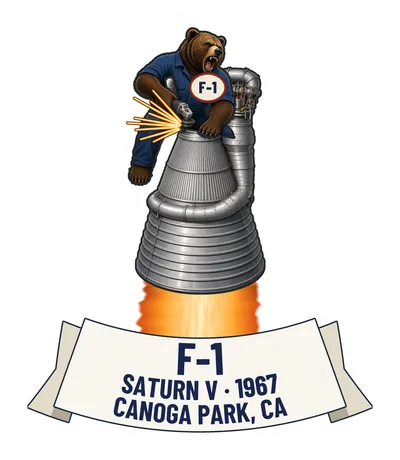
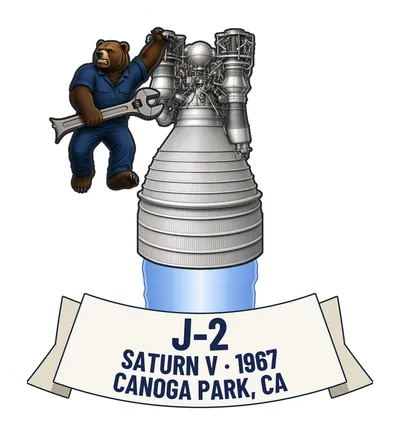
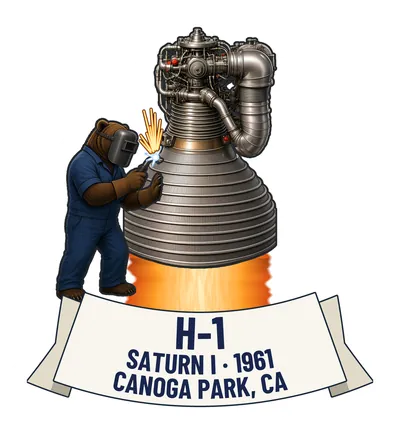
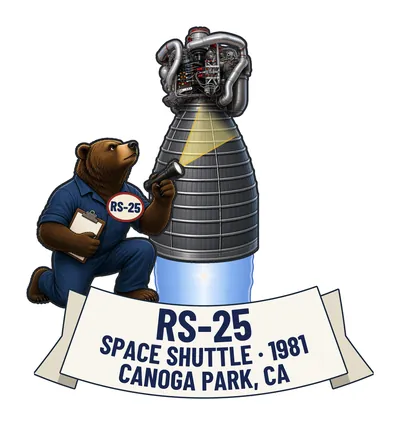
Our first designs come from the big liquid-fuel engines that were built in Canoga Park, in the west San Fernando Valley, and test-fired in the Simi Hills next door. Four of them get their own sticker in our engine series. Here's what each one did.
F-1: Saturn V first stage
Propellants
Liquid oxygen and RP-1 kerosene
Thrust
About 1.5 million lbf at sea level, per engine
Flew on
Saturn V (five per S-IC first stage)
Five F-1s lifted every Saturn V off the pad, together making about 7.5 million pounds of thrust. The first full-thrust, long-duration F-1 test ran in May 1962. It's still the most powerful single-chamber liquid-fuel rocket engine ever flown. An F-1 stands on display on De Soto Avenue in Canoga Park, across from the plant where it was built.
Saturn V (five on the S-II second stage, one on the S-IVB third stage) and Saturn IB (one on the S-IVB)
The J-2 was a hydrogen-fueled engine for the upper stages. Development was approved in June 1960, component testing started in the Simi Hills that November, and it first flew on the AS-201 mission on February 26, 1966. On the S-IVB stage it could be restarted in space, which is how the Apollo missions were sent from Earth orbit toward the Moon.
Up to about 205,000 lbf per engine (later versions)
Flew on
Saturn I (S-I stage) and Saturn IB (S-IB stage), in clusters of eight
Eight H-1s were clustered on the first stage of the Saturn I and Saturn IB. The engine grew out of the family of kerosene engines that also powered the Thor and Jupiter missiles, and the Saturn I first flew in 1961.
About 491,000 lbf (vacuum) at the 104.5% level flown on the Space Shuttle
Flew on
Space Shuttle (three per orbiter); SLS core stage (four)
The first complete RS-25 was test-fired on March 16, 1977, after its final assembly line was set up in Canoga Park. It first flew on STS-1 on April 12, 1981, and powered all 135 Space Shuttle missions. It's one of the most tested large rocket engines in history, with more than 3,000 starts. Today four RS-25s power the core stage of SLS, which launched Artemis I in November 2022. Ground testing for SLS runs at Stennis Space Center in Mississippi.
For decades the Canoga Park engine plant, on the west side of the San Fernando Valley, built large liquid-fuel rocket engines, including the F-1 and the RS-25. Engines and parts were test-fired a few miles west at the Santa Susana Field Laboratory, a site in the Simi Hills of Ventura County. From 1949 to 2006 it was used mainly to develop and test liquid-propellant rocket engines for the U.S. space program. The site is no longer active and is now under a state-supervised environmental cleanup.
We grew up around that history, which is why our first designs say "Canoga Park." More rocket engines and nozzles are on the way.
Thrust figures and mission counts were cross-checked against the U.S. space agency's published SLS RS-25 fact sheet, its F-1 test-history page, and the Apollo-era Saturn launch vehicle press kit.